

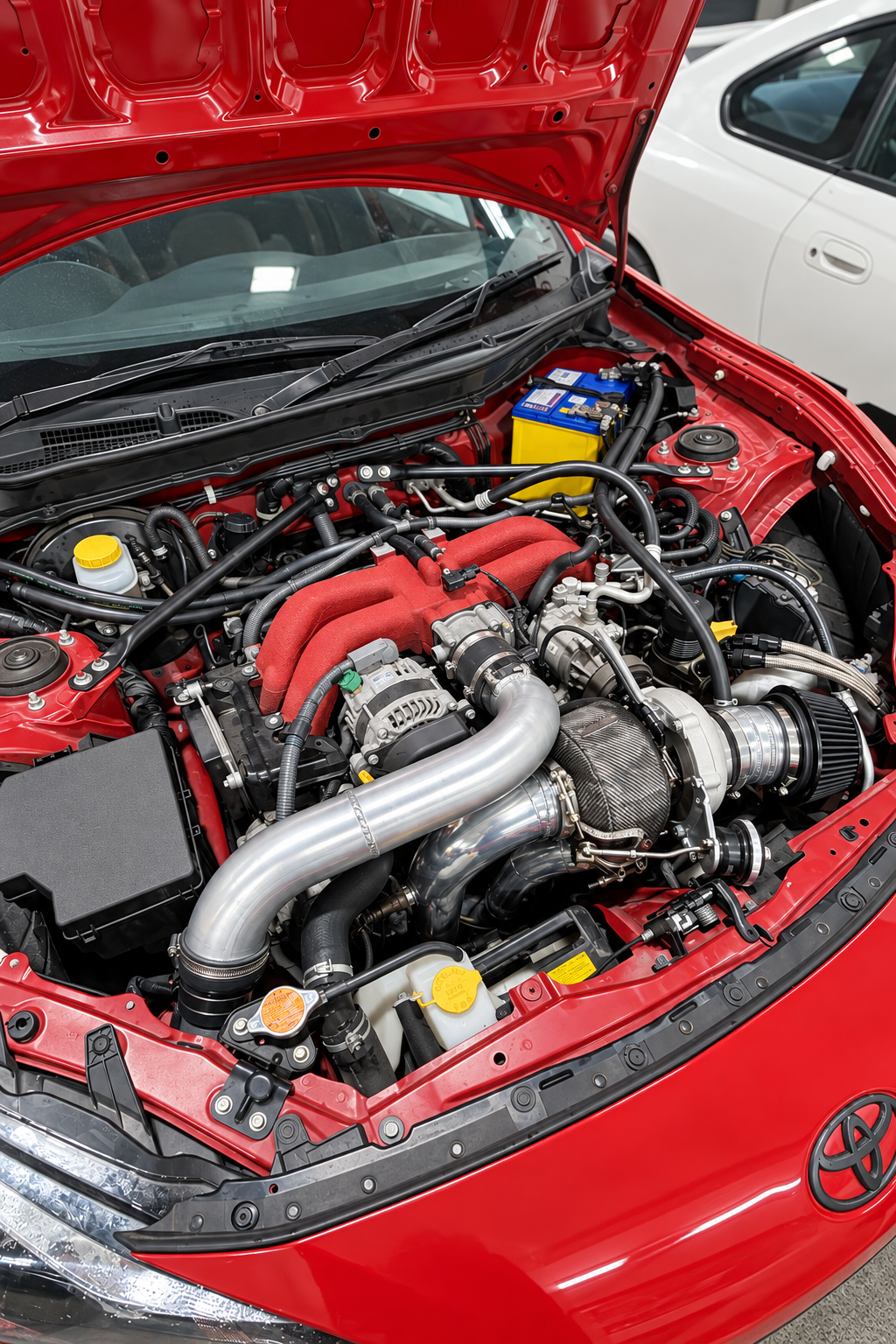
We build our 86/BRZ/GR86 turbo kits around the Garrett G30 frame, not the smaller G25, because it gives the 2.0L and 2.4L boxer room to grow without running out of turbo. Here is why it works so well on this platform.

The problem with going too small: cylinder pressure at low rpm
A smaller turbo like the G25 spools very early. That sounds ideal on a 2.0L, but it is the main problem. The engine gets full boost at low rpm, where volumetric efficiency is already high. This produces high peak cylinder pressure at low revs.
That is the worst place to have it. At high rpm, the inertia of the pistons and rods works against the gas load as the piston approaches TDC, which reduces the net load on the rod bearings and bottom end. At low rpm there is little inertia to offset it, so almost all of the cylinder pressure goes straight into the rods, bearings and crank. Add the stock engine's high compression ratio and the risk of knock and low-speed pre-ignition goes up as well.
A good tuner will see this and protect the engine by limiting boost and torque in the low rev range. That works, but it creates the next problem. The turbo is capable of spooling early, but the tune has to hold it back. The car feels flat down low, spools lazily, then comes on hard. You paid for a quick-spooling turbo and the tune has to take that away to keep the engine alive.
Why the G30 frame suits the FA20 and FA24

- Boost builds with rpm, not before it. The G30 frame spools a little later, so boost and cylinder pressure rise in step with engine speed. Peak cylinder pressure arrives where inertial loads are higher and the bottom end is better placed to take it.
- A tune that can use the turbo. With less need to cut low-rpm boost to protect the engine, the tuner can run a smooth boost curve from the mid-range up. The result is a car that drives well down low and pulls cleanly through the rev range, not a flat spot followed by a spike.
- Lower drive pressure at high rpm. A larger turbine and compressor flow more air before drive pressure climbs. A small frame pushed hard builds exhaust back pressure well above boost pressure, which leaves more residual exhaust gas in the cylinder and raises knock tendency. The G30 keeps that ratio healthier, so the engine makes more power with less heat.
- Cooler, denser intake charge. A larger compressor stays in its efficient range at the same airflow, so it makes less heat per unit of boost. That helps on a high-compression engine that is already knock-limited.
- Headroom. The G30 doesn't run out of flow at higher revs, and the 86/BRZ/GR86 likes to rev. The same kit carries you from a mild street tune to a serious E85 setup, so you don't buy twice.
G30-660 or G30-770?
Both sit on the same frame, so the kit, manifold and fitment are identical. You choose when you order:
- G30-660: the sensible choice for a street car that wants quick response and strong mid-range.
- G30-770: for builders who want more top-end headroom and plan to push the car harder.
With a proper tune, you can expect around 300 wheel horsepower on 98 octane and around 400 on E85. Professional tuning is required.
What's in the kit
Everything you need is in the box: manifold and downpipe, turbo, wastegate, V-band clamps, baffled large-capacity oil sump, lines and fittings, intercooler piping, silicone joiners and hose clamps. We make kits for the GT86/BRZ/FR-S (2012–2021, FA20) and the GR86/BRZ (2021 onwards, FA24).

The short version
Smaller turbos spool quickly, but that puts high cylinder pressure on the bottom end at low rpm. To manage it, the tune has to restrict early boost, and you lose the response you bought them for. The G30 frame builds boost with rpm, keeps cylinder pressure and exhaust back pressure under control, and gives the tuner room to make a car that drives well from idle to redline. That is why it's the frame we build around.
Ready to order? Pick your car on our turbo systems page, or message us if you want help choosing between the G30-660 and G30-770.