

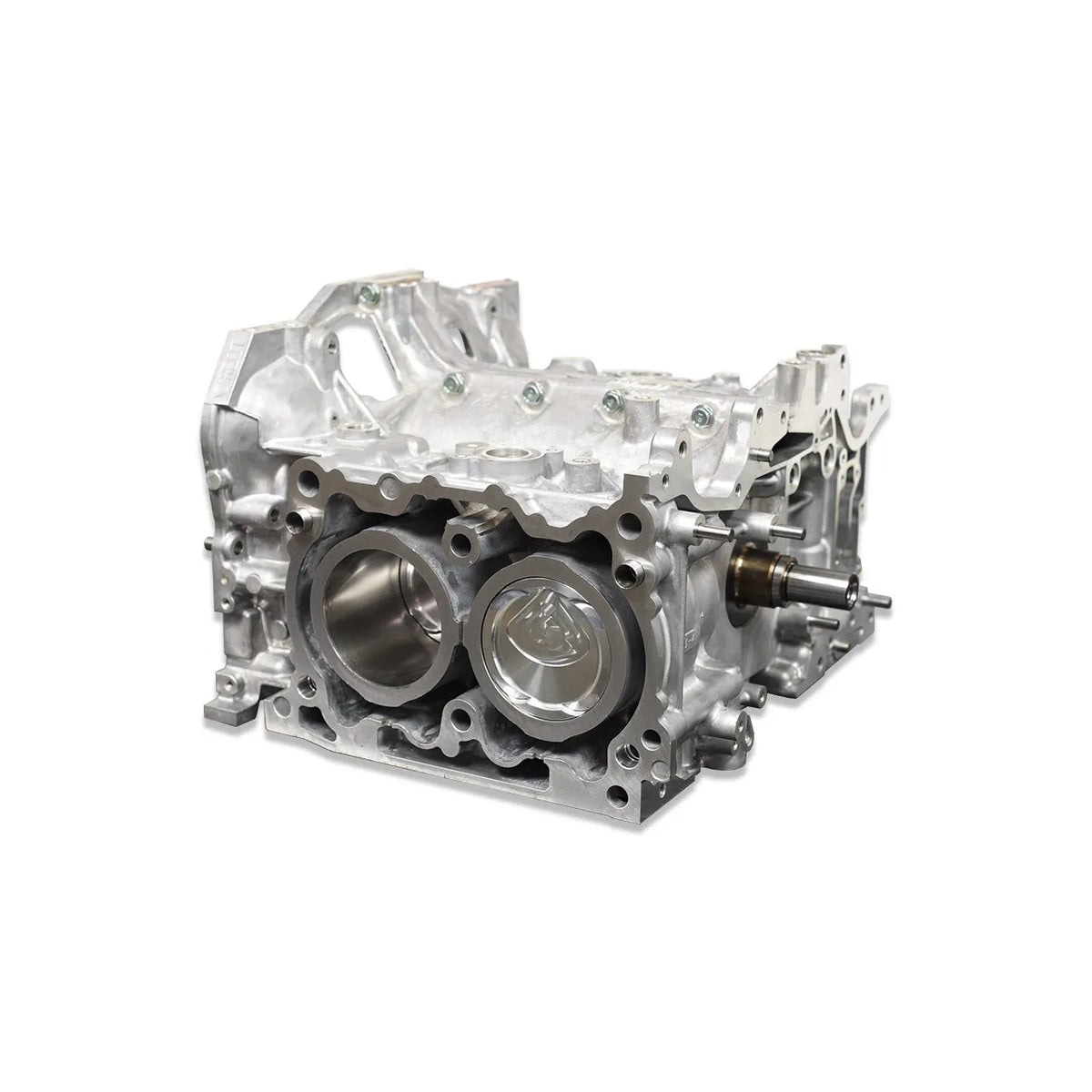
Engine builds come in two main forms: a short block, and a long block. A long block is the same thing as a complete engine, so we use those names interchangeably. They are very different products with different costs, work involved and freight. Here is what each one includes and how to choose.
Short block

A short block is the bottom end of the engine, assembled. It includes the engine block, crankshaft, connecting rods and pistons. It does not include the cylinder heads or valvetrain.
The bottom end is the part that takes the cylinder pressure. Every power increase from boost, E85 or a bigger turbo ends up as load on the rods, pistons, bearings and crank. That is why a forged short block is the usual upgrade for a high-power build.
What you reuse: your cylinder heads and valvetrain, and everything external to the engine. You need to transfer these across to the new short block, and you should have the heads inspected and in good condition first.
Best for: a bottom-end failure, or an engine that has been damaged, where the heads are still good. Also the right choice if you are building for more power and want to strengthen the bottom end, and you are happy to reuse your own top end.
Long block (complete engine)

A long block is a short block with the cylinder heads and valvetrain already fitted, so you receive an assembled engine ready to be fitted to the car. We treat a long block and a complete engine as the same thing.
What you reuse: only the external parts, such as the intake and exhaust manifolds, accessories and sensors.
Best for: when both the top end and the bottom end need work, or when you want a complete, known-good engine so there is less to transfer, assemble and check. It saves time and removes the risk of reusing a worn or damaged head.
Short block vs long block side by side
| Short block | Long block (complete engine) | |
|---|---|---|
| Includes | Block, crank, rods, pistons | Short block plus cylinder heads and valvetrain |
| You reuse | Your heads, valvetrain and externals | Externals only |
| Work involved | More. Heads must be removed, checked and refitted. | Less. Swap the engine and move the externals across. |
| Cost | Lower to buy. | Higher to buy, with less extra work on your end. |
| Risk | You are relying on your existing heads being good. | Top and bottom end are both new and matched. |
| Freight weight | About 50kg | About 100kg |
Forged or factory internals?
Forged pistons and rods are built to handle the higher cylinder pressures that come with boost and E85. If you plan to stay close to stock power, a standard rebuild is enough. For a turbo car making serious power, forged internals give you a safer margin. See our engine range for forged short blocks and long blocks.
How to decide
- Bottom end failed or building for big power, and your heads are in good condition: short block.
- Top end and bottom end both need work, or you want the simplest swap: long block.
Freight and lead times
These are heavy items, so freight is charged by weight. Ordering more than one increases the freight cost. Many of our engines are made to order, so allow for build time. Professional installation is recommended, and your engine should be run in and checked as set out in our engine warranty policy.
Not sure which one you need? Message us with your car and your goals and we'll point you to the right option.