

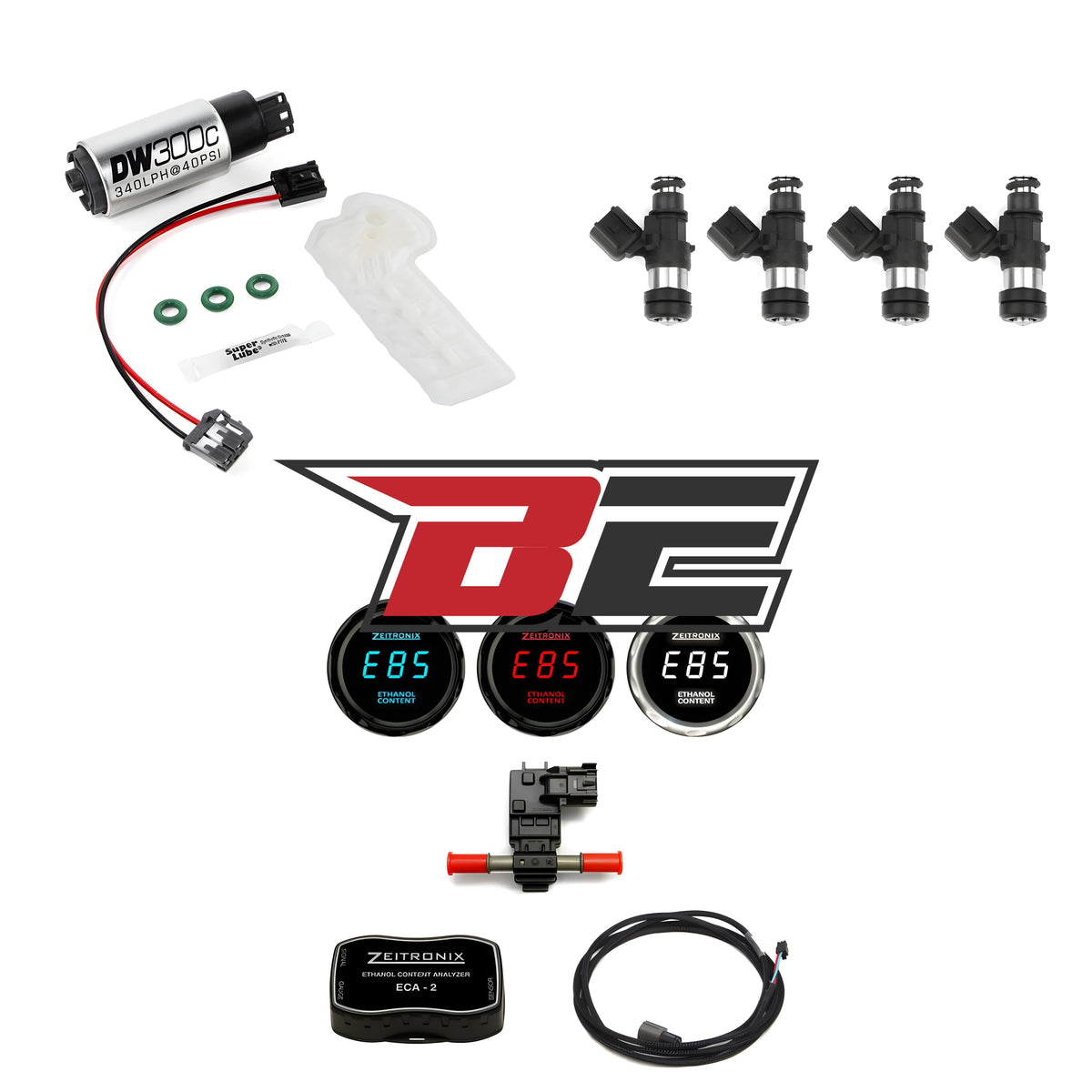
Switching a turbo car from 98 octane to E85 is the biggest single step up in power available from fuel alone. The same applies whether you drive a turbo 86/BRZ/GR86 or a BMW B48 or B58. On our 86/BRZ/GR86 turbo kits, a proper tune is around 300 wheel horsepower on 98 octane and around 400 on E85. Here is a direct comparison, the published numbers behind it, and what it means for your car.
98 octane vs E85 at a glance
| 98 octane | E85 | |
|---|---|---|
| Knock resistance | 98 RON. Boost and timing are limited by knock. | Often listed at around 105 RON, and has performed like race fuels rated 116+ MON in testing. |
| Charge cooling | Some. | A lot. Ethanol has a higher latent heat of evaporation, so it absorbs more heat from the charge. |
| Air-fuel ratio (stoich) | About 14.7:1 | About 9.8:1 |
| Fuel volume needed | Baseline. | Typically around 35 to 40 percent more fuel for the same power. |
| Energy content | Baseline. | Ethanol has about 30 percent less energy per volume than gasoline, which is why you use more of it. |
| Oxygen in the fuel | None to speak of. | About 30 percent oxygen by weight, which is why it needs so much more fuel to run at the right ratio. |
| Fuel system | Factory is fine at modest power. | Usually needs larger injectors and fuel pumps. |
| Fuel economy | Better. | Noticeably worse, because more fuel is burned for the same distance. |
| Availability | Almost everywhere. | Limited stations. Plan your fill-ups. |
| Ethanol content | Consistent. | Nominally 85 percent. Winter blends can drop to roughly 60 to 70 percent to help cold starting. |
| Tune | Professional tune required. | Professional E85 tune required. Not a simple switch-over. |
The numbers: a published FA20 test
HP Academy tested a turbocharged FA20 Toyota 86 (12.5:1 compression, Borg Warner EFR 6758 turbo, MoTeC M150 ECU) on pump gas and E85. This is a different turbo setup to ours, so treat it as an example of what the fuel does, not a prediction for any kit.
| Fuel | Boost | Ignition timing | Wheel power |
|---|---|---|---|
| Stock (baseline) | None | Stock | 114 kW |
| Pump gas | 7 psi | Knock-limited | 198 kW |
| E85 | 7 psi | 6 to 8 degrees more advance than pump gas | 226 kW |
| E85 | 9.5 psi | At MBT, no detonation | 266 kW |
Two things stand out. At the same 7 psi, E85 made about 14 percent more power than pump gas, because the engine could run 6 to 8 degrees more timing. Then, because E85 resisted knock, boost could go up another 2.5 psi with no detonation, and power climbed to 266 kW. The test was stopped there to protect the stock engine, not because the fuel ran out of room. On a naturally aspirated engine that is not knock-limited, the same author saw only about 5 percent more power, which shows how much of the gain on a turbo car comes from knock resistance.
Why E85 makes more power on a turbo car
Turbo petrol engines run into knock before they run out of turbo. The tuner has to pull timing or limit boost to keep the engine safe on 98. E85 resists knock much better, so the tuner can run more boost and more timing. The cooling effect lowers combustion temperatures as well, so the engine makes more power with less thermal stress.
This helps most on engines that are already knock-limited, such as the high compression FA20 and FA24 in the 86/BRZ/GR86, and the direct-injection BMW B48 and B58.
The fuel system is the limit

The extra fuel volume is the main thing to plan for. On the 86/BRZ/GR86, that usually means larger injectors and fuel pumps, with the lines and fittings to match. See our fueling range.
On a direct-injection BMW like the B58, the factory high-pressure fuel pump is the first limit on fuelling, and E85 puts more demand on it than pump gas. One published guide puts the stock pump's limit at roughly 450 to 500 wheel horsepower on pump gas, and lower at roughly 400 to 425 on E30. Owners commonly upgrade the high-pressure pump, or add port injection or charge pipe injection to supply the extra fuel. The B48 uses a similar direct-injection setup. If you are planning E85 on a BMW, message us with your car and power goals so we can plan the fuel system with you.
Flex fuel: one car, either fuel
Because the blend varies, an ethanol content sensor is worth fitting. It lets the ECU read the blend and adjust fuel and timing in real time, so you can run 98, E85 or any mix of the two without retuning each time.

You can also check the blend yourself with a simple ethanol test bottle, as shown above. Mix a sample of fuel with water, shake it, and read the ethanol percentage off the scale. It is a quick way to see whether a winter blend is lower than the 85 percent on the pump.
Which should you run?

- Stay on 98 if E85 is hard to find where you drive, you want the best economy, or you want a simple street setup. A well-tuned 98 car is still strong and reliable.
- Move to E85 if you can fill up with it regularly and want more power from the same engine and turbo. It also gives you a bigger safety margin against knock at higher boost.
Either way, the tune matters more than the fuel. A professional tune for the fuel and setup you actually run is what keeps the engine safe. See our turbo systems for the 86/BRZ/GR86, or message us and we'll help you plan the right setup.
Sources: HP Academy: How much more power can you make on E85?, BMW Tuning: B58 fueling mods guide and US Department of Energy: Ethanol fuel basics.